Not much in the news today, just the European Commission sending a ‘letter of formal notice’ that it believes the U.K. has breached the terms of the Withdrawal Agreement. The U.K. has a month to respond, but the trade talks are still continuing.
Brexit in the news, 30/09/2020.
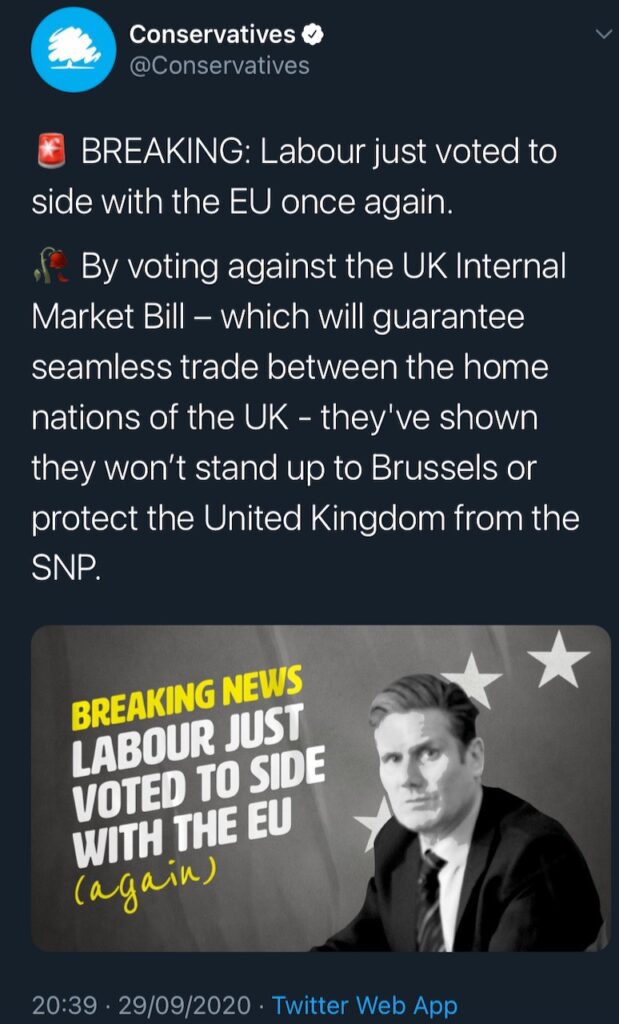
The Internal Market Bill passed the Commons yesterday and is now on its way to the Lords. How did the Tories mark the passing of a bill that breaks international law? By suggesting the the opposition “sides with the EU” and getting a dig in at the SNP too. Bizarre (or maybe desperate).
In other news, cars (and other things made in the UK) will not qualify for zero-tariff trade, if they contain more than a given percentage of parts from other countries (Japan and Turkey are being used as examples, as is a figure of 50% of parts). Many of the key components of cars made in factories in the UK are sourced from outside Europe, and so they will attract tariffs if built in the UK and then exported from the UK to the EU.
We’re apparently offering a concession on fishing as part a a Brexit sweetener.
The NHS Test and Trace app (part the third)
A couple of days since the launch of the NHS test and trace app and it continues to be in the news.
The BBC’s Rory Cellan-Jones has written an article that the abandoned initial app ‘worked on more phones.’ True, perhaps, but there is a balance between accuracy and privacy. Plenty of people don’t want to download the new app that uses the Exposure Notification API. How many would want to download one that collected information centrally as the original one did?
The complaint today is that you can’t acknowledge a test from the NHS or Public Health England (pillar 1 tests), only from the private (‘Nightingale’) testing centres — the pillar 2 tests.
In contrast, on Wednesday people were expecting it to be very easy to enter a false positive test into the app and cause a barrage of unneeded messages to isolate.
To avoid the latter, you need some way to authenticate a test result.
Now, I don’t know what has gone on behind the scenes, but I can easily see why it might be easier to set up a regime at the private labs working under contract than it is for the “on demand” tests being performed in the NHS.
The pillar 2 tests that can be entered into the app account for two-thirds of the testing capacity, so whilst it is essential to get a way of entering the pillar 1 tests into the app (and even the pillar 4 statistical tests), this does not make the app useless.
I’d love to hear what the plans are for getting the pillar 1 and 4 tests into the app, but I can see how we got here, and I’d tend to think it is more likely to be because it hasn’t been possible to get the logistics co-ordinated in time rather than the commercial conspiracy theories that are doing the rounds.
Update (ironically from the correspondent mentioned above):
The NHS Test and Trace app (updated)
A couple of weeks ago, I described why I would probably feel safe installing the NHS Test and Trace app which went live today.
Reader, I installed it.
I’ve spent a bit of time today listening to people that have concerns with the app. All of these boil down to “we don’t trust the government.” Trust has been so eroded by the actions of Cummings et al, that people are justifiably distrustful of an NHS/government app.
That’s fine, I don’t trust the government either, but let me try to explain why in this case it doesn’t matter.
It uses the Apple/Google Exposure Notification API, which means that the app must abide by certain rules before it is allowed on the App Stores, and that includes not being able to track your location. If it doesn’t obey those rules, it doesn’t get put on the App Store.
One of the key points to stress is that all the hard work is done on your phone, and not uploaded to NHS servers. The QR codes you scan to ‘check in’ to a venue are only stored on your phone — and mean you don’t have to hand your personal details over to the venue instead.
There is a detailed privacy policy, including a summary and an ‘easy read’ version
The source code is available for all to see (and you can be sure lots of people are looking at it):
- https://github.com/nhsx/covid19-app-system-public
- https://github.com/nhsx/covid-19-app-android-ag-public
- https://github.com/nhsx/covid-19-app-ios-ag-public
There is a method to disclose vulnerabilities:
Concerns have been raised about the requirement for a relatively new smartphone. This is true, it requires iOS 13.5 or newer, or Android 6 or newer. An iPhone 6 will not support it, even though they were being sold up until September 2018, but the iPhone 6s (which was launched one year later, but discontinued at the same time as the 6) will support it. My Samsung Galaxy S7 released in 2016 (running Android 8) does support it.
The reason for this is not the NHS, it’s the operating systems that support the Exposure Notification API, and the privacy strength of the app comes from using that instead of the original plan for an app developed entirely in-house.
It is perfect? I doubt it. For a start, you need to be in proximity to someone for 15 minutes who later tests positive for it to count as a ‘high risk encounter.’ Is it better than writing your contact details in a book? I think so.
Brexit in the news, 23/09/2020.
It has been a week since the last post, mainly because the news has been focusing on COVID-19 rather than Brexit, but here we are again.
The news of forecast queues of 7,000 lorries is doing the rounds again today, just as it did on the 16th, and as it did two weeks before that. The haulage industry is also hitting back at the government. Along with this, the news about lorries requiring a permit to even enter Kent has also picked up traction again.
JPMorgan is moving $23obn of assets from the U.K. to Germany in preparation for Brexit.
Meanwhile, an LSE report from The UK in a Changing Europe calculates that the long-term cost of a Brexit without a trade deal to the economy is going to be twice that of COVID.
Then there is the Galileo (Non-GPS global positioning system) saga (in, out, in, out, shake it all about), and I see from this report on RTE, that there is a procurement underway for where in the EU the 250 jobs in Reading for the European Centre for Medium-Range Weather Forecasting will move to.
Brexit in the news, 16/09/2020.
In news that will surprise precisely no-one following recent reports about the timeline for delivering the SMART Freight System, it won’t be ready for January 1st.
[Update: This BBC News article reports that the government claims that beta software means that it is fully operational. This is probably true in the world of Dominic Cummings that worships at the feet of the tech giants. Meanwhile, us more operational folk realise ‘alpha’ is software reading for a bit of internal testing, and ‘beta’ means a bit more widespread testing, it is not production-ready.]
Meanwhile, as the Internal Markets Bill continues in committee, there are rumours that Boris Johnson has proposed a deal that will allow Tory rebels to support the bill, relating to the amendment proposed by Sir Bob Neill (the amendment was there will be a parliamentary vote before it is triggered, the deal apparently promises ‘extra parliamentary oversight’), but not changing what the UK would do in that event. As has been pointed out, this puts Tory party unity above making progress with the EU, as nothing has changed about the UK ultimately proposing to break international law.
Answering to the Liaison Committee, the Prime Minister said that the UK may put tariffs on imports from the EU in the event of no-deal, which means they’d need to apply to all imports. Far removed from the tariff-free trade we were promised by the Brexiters.
In news that’s a little more amusing, parliament voted through a Labour amendment to the Fisheries Bill because it has mistakenly been labelled as a Conservative amendment. Good to know they’re paying attention to the content rather than just whose affiliation is at the top, eh?
Duty-free after Brexit
I missed this last week, but the government has published what duty free we will be allowed when travelling after the 1st January.
It is being branded as ‘extending duty free to the EU’, but that’s only partially true.
We will indeed be able to bring duty-free alcohol and tobacco back into the UK, subject to the following limits (the article fails to mention we can bring back what we want as members of the EU or during the transition period).
Alcohol
- 42 litres of beer
- 18 litres of still wine
- 4 litres of spirits OR 9 litres of sparkling wine, fortified wine or any alcoholic beverage less than 22% ABV
Tobacco
- 200 cigarettes OR
- 100 cigarillos OR
- 50 cigars OR
- 250g tobacco OR
- 200 sticks of tobacco for heating
- or any proportional combination of the above
However, it also says:
We are also ending tax-free sales in airports of goods such as electronics and clothing for passengers travelling to non-EU countries, following concerns that the tax-concession is not always passed on to consumers in the airport. In some instances these tax-free goods are brought back into the country by UK residents, putting high street retailers at a disadvantage.
Either retailers are passing the discount on to the passengers, which puts the high street retailers at a disadvantage, or they are not, surely? It can’t be both.
I have found the odd discount with duty free electronic shopping, but they’re rarely large, and will that stop people buying duty-free electronics, or will they just do it at the other end on the way back?
Brexit in the news, 15/09/2020
The morning after the debate before.
Despite Ed Miliband giving what is being described as one of the best speeches in the house for some time, the Internal Markets Bill passed its first reading and how headed into committee stage today. Notably, doing the rounds of breakfast news this morning, the Home Secretary Priti Patel started rowing back on the language about breaking the law and the BBC is describing it as ‘over-riding’ existing law rather than ‘breaking’ it.
Two weeks after road hauliers warned of the same, The Guardian reports that leaked government documents claim preparations are in place for delays of two days on Channel crossings, and queues of 7,000 lorries. Lorries will not even be able to enter Kent unless they’ve filed the appropriate paperwork and could be fined £300 for doing so without it.
Brexit in the news, 14/09/2020.
This a just going to be a link to Ian Dunt’s live tweeting of the debate on the Internal Markets Bill. Read and enjoy. Or weep. Mainly weep, other than rue the face that we as a country didn’t choose to go for chaos with Ed Miliband.
The NHS ‘Test and Trace’ App
Today the government announced the ‘new’ test and trace (I must not call it track and trace) app will be available later this month.
They also announced that hospitality venues (or, I presume, anywhere where people gather) can download QR codes to ‘check in’ to locations when they arrive.
This latter bit rang alarm bells with me. The new app is using the Apple and Google ‘Exposure Notification’ API, which does not track location, it just tracks random IDs generated by other phones, and when one person gets a positive test, it sends notifications back to those you’ve crossed paths with.
‘Hmm,’ I thought, ‘is checking in with QR codes a way to get around the privacy protections of the Exposure Notification system?’
Apple’s Developer Documentation says:
3.3 A Contact Tracing App may not use location-based APIs, may not use Bluetooth functionality (excluding Bluetooth functionality included in the Exposure Notification APIs) and may not collect any device information to identify the precise location of users. In addition, Contact Tracing Apps are prohibited from using frameworks or APIs in the Apple Software that enable access to personally identifiable information (e.g., Photos, Contacts), unless otherwise agreed by Apple.
https://developer.apple.com/contact/request/download/Exposure_Notification_Addendum.pdf
Checking into places (and probably reporting that back to gov.uk’s servers) would surely breach that agreement.
It does, but I was pleasantly surprised to see that the app doesn’t report those check-ins back. They are only stored on your phone, and can be recalled if you do test positive and call the Test and Trace hotline.
There is a detailed privacy notice for the app, which says:
The App has been designed to use as little personal data and information as possible. All the data that could directly identify you is held on your phone and not shared anywhere else.
Specifically on the venue check-in, it says:
When you set up the App, it will ask you for permission to use the camera on your device in order to check in to venues using QR codes. If you check in to a venue, the information will be stored on your phone for 21 days. It will not be shared with anyone else. The choice of 21 days takes into account the 14-day incubation period, and 7-day infectious period of the virus.
You will be able to see the list of venues where you have checked in on your phone. You can delete the whole list at any time. In future versions of the App you will be able to choose to delete single items from the list. No one else will know where you have checked in unless you choose to tell them, and the data will not be shared by the App.
At the same URL there is also an illustration of the various ‘user journeys’ through the app, which is very helpful. Even better, the app and the server back-end code is available on the NHS GitHub site.
This is so much better than I was expecting, and reassures me I can safely install the app when it is released. It’s also several orders of magnitude better than the original attempt at a home-grown app that had few, if any, of the protections of the Apple/Google Exposure Notification API.