Rob’s politics notes, 5th January 2021.

We are now in the third national lockdown (which “may last for months” and whilst restrictions may be lifted for the warmer summer months of 2021, some may be re-imposed for winter). The same businesses that had support before are going to get support again, the same businesses that were #ExcludedUK before are excluded again.

It sucks, there are no two ways about it, but I don’t see what the options are either. My Dad is an extremely vulnerable person (85, triple heart bypass, Parkinson’s disease), and checking with the NHS, my wife has been told to contact the GP today. I suspect it is ‘flu as the symptoms are fairly typical and I’m probably fine because I had a shot last October. On the other hand, if it is COVID, that may now make me an asymptomatic carrier.

The BBC is, harking to my younger days, going to start broadcasting educational programmes. CBBC for primary school children and BBC Two for secondary school children, starting next Monday. Anyway, this is diverging from politics.

Yesterday, I said that border traffic was low and that the Brexit queues had yet to materialise at the ports. That’s not to say there haven’t been problems. Reuters reports that Paris M&S shops have little to no stock of fresh food.

Meanwhile, there have been multiple occurrences of problems travelling abroad, whether the destination is Sweden, Spain, Netherlands or Germany. Some of those are because of COVID regulations now that we are outside the EU.

Rob’s politics notes. 4th January 2021

Today is the day that we enter lockdown number three, or at least it is expected to be. Boris Johnson is to make an address to the nation at 8pm, but ITV’s Robert Peston apparently already knows what he is going to say.

I wonder why there is an eight hour delay between announcing the address and making the address, if the content is already known, other than theatre and giving the speechwriters time to come up with more bombastic wartime metaphors. Sturgeon simply announced Scotland’s lockdown during the day.

Back on Brexit, and there haven’t been any long tailbacks at the ports, but Bloomberg reports that it may be the calm before the storm due to pre-Brexit stockpiling leaving traffic levels even lower than they usually are in the New Year.

Is it the end of Brexit? Or the beginning? Or the beginning of the end? Or the end of the beginning?

In less than ten hours’ time, the transition period will end and the UK will change its relationship with the EU. I won’t say “end,” because we’ll obviously still have a relationship with the EU, just a very, very different one. So I don’t know if this marks the end of Brexit, the beginning of Brexit, or more likely, the end of the Brexit process and the start of our position outside the EU.

One thing is for certain, there are rights we have undoubtedly lost. The freedom to live in another European country. A single market for goods and services (including financial services). Who knows what travel will be like when the pandemic is over, but I foresee much more time spent queuing at the border of other countries.

Trade will not be the same, regardless of the ‘deal’ that has been struck. There will be more paperwork, there will be more customs declarations, and there will be delays. Time will tell how bad those are going to be. We have created an internal border between Northern Ireland and Great Britain, and perhaps another soft one between Kent and the rest of the UK for lorries if they’re to be prevented from entering the county without the right paperwork.

Speaking of which, how are those customs systems progressing? Bloomberg is reporting that shipping firms are refusing contracts to bring goods into the UK, fearing their trucks and drivers will be sitting idle waiting to enter or exit the country. The chaos when France shut its borders following the discovery of a new variant of COVID was a taste of things to come.

I need to read up on more details — particularly what it means for data storage and privacy (I think the headline is that agreement wasn’t possible and the UK agreed to be bound by the EU’s terms for another six months), this “Erasmus replacement” scheme, and out of sheer curiosity, what it means for Gibraltar*.

I did not travel much as a child, or even as a young adult, but since starting a lot of European work in 1999 I’ve tried to make up for that gap in the intervening 21 years. Today is a sad day, and I can only cling on to the hope that some have expressed that the Brexit ‘deal’ is going to inevitably end with closer integration as it is reviewed every five years and in the meantime any transgressions by the UK are dealt with firmly by the EU. I don’t want to see the UK fail (my wife hints that we deserve all we get), but there can’t be many that still think we’ve made it easier for ourselves at the end of this?

Nobody reads this, but Happy New Year to you regardless. I think in the New Year I shall attempt to start to make this into a wider political blog (like there aren’t many of those around), if for no other reason than to help me keep track of all the broken promises that emanate from Westminster.

* Moments after I typed that, my phone pinged with an alert to say a draft deal between the UK and the EU on Gibraltar has been agreed which allows it to join European programmes, including Shengen! https://www.theguardian.com/world/2020/dec/31/spain-and-uk-reach-draft-deal-on-post-brexit-status-of-gibraltar
Brexit in the news, 23/10/2020.

It’s been quiet since the negotiations restarted yesterday, with the news full of the US presidential debate, and the Tories voting against the provision of free school meals during the holidays whilst families suffer through furlough and redundancy.

One story that will send a shudder through the bones of any traveller is that the UK is asking for its citizens (subjects!) to be able to use e-passport gates at EU borders, but the EU saying that is against EU law. Travel may be subdued for now, but I’m not looking forward to what that is going to mean when it restarts next year.

The UK’s participation in the EU-funded Horizon Europe research projects is under threat from a gap in funding. The cost of our entry to the programme is currently set above the value of the research grants that the UK derives from it to the tune of about £3bn.

Brexit in the news, 19/10/2020.

After a good start (and I simply mean in the frequency of posts, not the quality of their content), as with most blogs, updating this has slowed down a bit. Partly that’s because keeping up with the Brexit news at the moment is so dispiriting whilst the second wave of Coronavirus is hitting us full-on and my wife and I wonder when we will next see our families in Wales, which is likely to go into a national lockdown this week.

However, the deadline for Brexit looms large, and any brief moments of hope in trade talks soon seem to be dashed with bluff and bluster.

This week the Internal Markets Bill is set to be debated in the House of Lords. Last week, the Lords’ Select Committee on the Constitution published a report that included, in its summary:

The Bill adopts an unnecessarily heavy-handed approach to reconciling the demands of free trade within the UK and the need to respect the role and responsibilities of devolved institutions.

The rule of law requires that everyone—from government ministers to the person on the street—be bound by, and entitled to the benefit of, the law.

A government that disregards the rule of law cannot easily restore it. … Any government that seeks to secure widespread compliance with the law must itself adhere to it.

Meanwhile, the government’s official Twitter accounts have been starting a new campaign for us to get ready for Brexit this morning.

The prize must go to the Home Office for “getting ready takes longer than you think.” Is this self-aware sarcasm?

Glad that is all sorted and we now know the exact nature of our future relationship with Europe. Don’t we?

It beggars belief that Michael Gove is still claiming that the UK “holds all the cards” in the negotiations. Who is falling for this claptrap? The same can be said for reframing the lack of a trade deal and falling back to trading on WTO terms as “an Australian-style deal.”

Talks continue…

Brexit in the news, 30/09/2020.

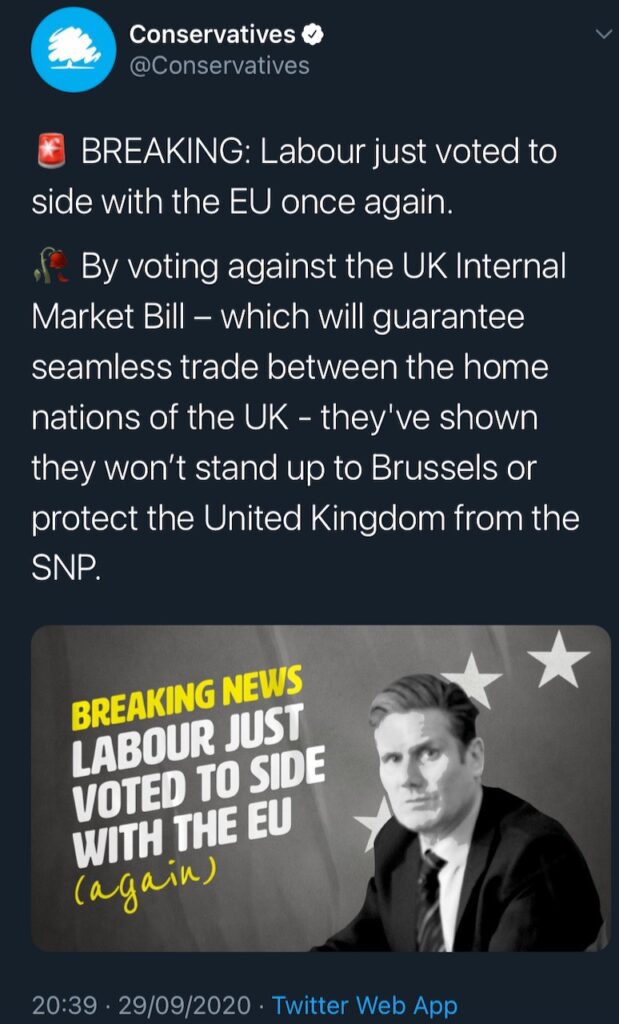
The Internal Market Bill passed the Commons yesterday and is now on its way to the Lords.  How did the Tories mark the passing of a bill that breaks international law?  By suggesting the the opposition “sides with the EU” and getting a dig in at the SNP too. Bizarre (or maybe desperate).

In other news, cars (and other things made in the UK) will not qualify for zero-tariff trade, if they contain more than a given percentage of parts from other countries (Japan and Turkey are being used as examples, as is a figure of 50% of parts).  Many of the key components of cars made in factories in the UK are sourced from outside Europe, and so they will attract tariffs if built in the UK and then exported from the UK to the EU.

We’re apparently offering a concession on fishing as part a a Brexit sweetener.

Brexit in the news, 23/09/2020.

It has been a week since the last post, mainly because the news has been focusing on COVID-19 rather than Brexit, but here we are again.

The news of forecast queues of 7,000 lorries is doing the rounds again today, just as it did on the 16th, and as it did two weeks before that. The haulage industry is also hitting back at the government. Along with this, the news about lorries requiring a permit to even enter Kent has also picked up traction again.

JPMorgan is moving $23obn of assets from the U.K. to Germany in preparation for Brexit.

Meanwhile, an LSE report from The UK in a Changing Europe calculates that the long-term cost of a Brexit without a trade deal to the economy is going to be twice that of COVID.

Then there is the Galileo (Non-GPS global positioning system) saga (in, out, in, out, shake it all about), and I see from this report on RTE, that there is a procurement underway for where in the EU the 250 jobs in Reading for the European Centre for Medium-Range Weather Forecasting will move to.

Brexit in the news, 16/09/2020.

In news that will surprise precisely no-one following recent reports about the timeline for delivering the SMART Freight System, it won’t be ready for January 1st.

[Update: This BBC News article reports that the government claims that beta software means that it is fully operational. This is probably true in the world of Dominic Cummings that worships at the feet of the tech giants. Meanwhile, us more operational folk realise ‘alpha’ is software reading for a bit of internal testing, and ‘beta’ means a bit more widespread testing, it is not production-ready.]

Meanwhile, as the Internal Markets Bill continues in committee, there are rumours that Boris Johnson has proposed a deal that will allow Tory rebels to support the bill, relating to the amendment proposed by Sir Bob Neill (the amendment was there will be a parliamentary vote before it is triggered, the deal apparently promises ‘extra parliamentary oversight’), but not changing what the UK would do in that event. As has been pointed out, this puts Tory party unity above making progress with the EU, as nothing has changed about the UK ultimately proposing to break international law.

Answering to the Liaison Committee, the Prime Minister said that the UK may put tariffs on imports from the EU in the event of no-deal, which means they’d need to apply to all imports. Far removed from the tariff-free trade we were promised by the Brexiters.

In news that’s a little more amusing, parliament voted through a Labour amendment to the Fisheries Bill because it has mistakenly been labelled as a Conservative amendment. Good to know they’re paying attention to the content rather than just whose affiliation is at the top, eh?

Duty-free after Brexit

I missed this last week, but the government has published what duty free we will be allowed when travelling after the 1st January.

It is being branded as ‘extending duty free to the EU’, but that’s only partially true.

We will indeed be able to bring duty-free alcohol and tobacco back into the UK, subject to the following limits (the article fails to mention we can bring back what we want as members of the EU or during the transition period).

Alcohol

  • 42 litres of beer
  • 18 litres of still wine
  • 4 litres of spirits OR 9 litres of sparkling wine, fortified wine or any alcoholic beverage less than 22% ABV

Tobacco

  • 200 cigarettes OR
  • 100 cigarillos OR
  • 50 cigars OR
  • 250g tobacco OR
  • 200 sticks of tobacco for heating
  • or any proportional combination of the above

However, it also says:

We are also ending tax-free sales in airports of goods such as electronics and clothing for passengers travelling to non-EU countries, following concerns that the tax-concession is not always passed on to consumers in the airport. In some instances these tax-free goods are brought back into the country by UK residents, putting high street retailers at a disadvantage.

Either retailers are passing the discount on to the passengers, which puts the high street retailers at a disadvantage, or they are not, surely? It can’t be both.

I have found the odd discount with duty free electronic shopping, but they’re rarely large, and will that stop people buying duty-free electronics, or will they just do it at the other end on the way back?

By continuing to use the site, you agree to the use of cookies. more information

The cookie settings on this website are set to "allow cookies" to give you the best browsing experience possible. If you continue to use this website without changing your cookie settings or you click "Accept" below then you are consenting to this.

Close